Aug 21, 2014 | Uncategorized
Partners

First Québec cross-disciplinary group devoted to studying knowledge transfer (KT) in the field of social interventions, specifically with regard to educational, health and community services.

Canadian Institute of Health Research
The knoledge broker’s blog (french)
What is knowledge brokering ?
Brokering knowledge makes the project’s results (and those of other research projects) easily accessible to stakeholders and policy makers when assessing their needs and providing relevant and appropriate information. The knowledge broker’s task is to assist stakeholders of Kaya as of the beginning of the program. He will also have the opportunity to put their skills to the services of national decision makers as of early 2014. The broker’s work, which is an intervention in itself, is evaluated within the context of the research program.
Knowledge brokering : Reports
1627688
FXTSVQTM
items
1
year
desc
1
http://www.equitesante.org/wp-content/plugins/zotpress/
Some, D. T. (2014).
Lettre du courtier (année 1, no1). Ouagadougou.
Download
Some, D. T. (2014).
Lettre du courtier (année 1, no2). Ouagadougou.
Download
Some, D. T., Ridde, V., & Dagenais, C. (2014).
Les politiques de subvention/exemption de paiement au Burkina Faso.
Download
Some, D. T., Lane, J., Ridde, V., Dagenais, C., & Chiocchio, F. (2014).
Comment stimuler l’utilisation de la moustiquaire imprégnée d’insecticide au Burkina Faso ? (pp. 1–4).
Download
Jul 10, 2014 | Uncategorized
Jun 17, 2014 | equity of access to healthcare
Johri, M., Ridde, V., Heinmüller, R., & Haddad, S. (Soumis). User-fee elimination reduces maternal and child mortality: 1 year ex post impact evaluation and modelling study in Burkina Faso. Bulletin de l’Organisation mondiale de la Santé. [article]
Appendix 1:
Télécharger (PDF, 278KB)
Appendix 2:
Télécharger (PDF, 172KB)
May 29, 2014 | equity of access to healthcare, health policy analysis
New article published in Journal of Health Services Research & Policy
1627688
8M4GB7P4
items
1
default
asc
1
1
1
http://www.equitesante.org/wp-content/plugins/zotpress/
Torbica, A., Allegri, M. D., Belemsaga, D., Medina-Lara, A., & Ridde, V. (2014). What criteria guide national entrepreneurs’ policy decisions on user fee removal for maternal health care services? Use of a best-worst scaling choice experiment in West Africa.
Journal of Health Services Research & Policy.
https://doi.org/10.1177/1355819614533519 Download
Sep 17, 2013 | Uncategorized

Background
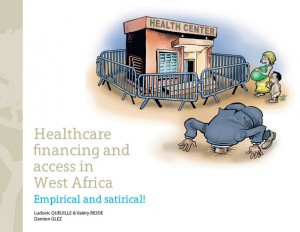
In West Africa, the health status of the population is precarious, particularly because of very poor access to healthcare services. In 2008, the European Community Humanitarian Office (ECHO), the German NGO Help, and the Direction régionale de la santé (DRS) du Sahel in Burkina Faso decided to experiment with user fee exemptions for children under five and pregnant or breastfeeding women. The project’s two objectives are to:
- provide medical treatment for vulnerable populations;
- improve the national health policy.
The project has four components:
- the intervention itself (subsidy for care provided to these vulnerable populations and measures to support this subsidy);
- evaluative research on the intervention;
- transfer and dissemination of the knowledge produced by the intervention;
- advocacy for policy change.
For the research and knowledge transfer activities, the project established a scientific partnership with the University of Montreal Hospital Research Centre (CRCHUM), and in particular, with Professor Valéry Ridde as scientific advisor. The CRCHUM’s research and knowledge transfer mandate, which it carries out in collaboration with the other partners, includes 1) identifying knowledge needs and setting priorities, 2) producing knowledge, 3) disseminating that knowledge, and 4) conducting activities to encourage its use.