Research and community-based interventions for health equity in Burkina Faso

Axis of research and intervention

Partners

First Québec cross-disciplinary group devoted to studying knowledge transfer (KT) in the field of social interventions, specifically with regard to educational, health and community services.

First Québec cross-disciplinary group devoted to studying knowledge transfer (KT) in the field of social interventions, specifically with regard to educational, health and community services.


Logo IRSC

Canadian Institute of Health Research

The knoledge broker’s blog (french)

Research and community-based interventions for health equity in Burkina Faso

This program takes place in Burkina Faso, given that the country is at the end of the classification of the Human Development Index – measured under the United Nations Program for Development (2010) – and its indicators of health and equity health are alarming. This suggests that the objectives of the Millennium Development Goals will not be achieved in 2015. However, the Commission on Social Determinants of Health of the World Health Organization (WHO), the World Bank and the Countdown to 2015 Core Group have provided an overview of theoretically effective interventions to improve health equity. In addition, a recent review shows that nearly 90% of interventions that follow a participatory and community process have beneficial effects on the population. However, if the content of these interventions is described in international reports, the conditions for their implementation and their effectiveness in natural experiments are still very poorly understood. Several meta-analyses show that the potential effectiveness of interventions is subjected to multiple reduction factors often exceeding 50%. This is especially true in Africa, where there is very little research on the subject. Furthermore, according to WHO, these interventions are rarely carried out in Burkina Faso.

The aim of the program is to document the effectiveness and the procedures of promising community-based interventions to improve health equity in the context of one of the world’s poorest countries. The primary objective is to evaluate community-based interventions that are currently underway in the health district of Kaya and that have been selected by the program’s stakeholders (researchers, practitioners, policy makers, communities) in a preliminary participatory planning process. The aim would be to provide evidence of their effectiveness regarding health equity. The second objective would be to articulate, implement and evaluate the best practices of community interventions favoring equity, based on the work and results of experiments using a participatory approach. It will also be important to take action and conduct research in accordance with ethical principles and negotiated partnership approaches with stakeholders, while having due regard to the application of the knowledge produced.

Evaluative research will be undertaken both on community interventions that are underway as well as on those created within the program. This project comprises several scientific assets that favor socially and scientifically relevant knowledge including:

  •  Intervention heterogeneity (nutrition, malaria, financial protection, family planning, etc.);
  • Intervention temporality (before 2012, during the program);
  • Variety of assessment type (impact, equity, process, sustainability, scalability);
  • Variety of methods of assessment (quantitative, qualitative, mixed);
  • Existence of a research infrastructure with exceptional population data for the region (demographic surveillance system with a panel of 50,000 people since 2007)

This program is also an opportunity to experience and evaluate the best research practices and potential interventions that could favor equity. These new practices will allow to meet the needs of knowledge in the following areas:

  •  Practice of collaborative research (North/South partnerships and relationships between researchers, stakeholders, policy makers, and community partnership);
  • Development and evaluation of a code of ethics;
  • Knowledge application through the implementation and evaluation of a strategy for knowledge brokering;
  • Identification of new community-based interventions aimed to improve health equity.

Finally, this project will advance the state of knowledge regarding three methodological developments:

  • The use of geographic information systems for health equity;
  • The use of a realistic approach in terms of evaluation;
  • The analysis of the impact of profits using a method allowing to evaluate the effects of an intervention without resorting to external standards of success

The interdisciplinary aspect of this program is guaranteed through the mobilization of researchers from different disciplines (anthropology, social sciences, geography) and experts in complementary fields (public health, evaluation, knowledge transfer, nutrition).

Publications:

Ridde, V., Agier, I., Bonnet, E., Carabali, M., Dabiré, K. R., Fournet, F., … Parra, B. (2016). Presence of three dengue serotypes in Ouagadougou (Burkina Faso): research and public health implications. Infectious Diseases of Poverty, 5(23). https://doi.org/10.1186/s40249-016-0120-2 Download
De Allegri, M., Tiendrebéogo, J., Müller, O., Yé, M., Jahn, A., & Ridde, V. (2015). Understanding home delivery in a context of user fee reduction: a cross-sectional mixed methods study in rural Burkina Faso. BMC Pregnancy and Childbirth, 15(1). https://doi.org/10.1186/s12884-015-0764-0 Download
Dagenais, C., Mc Sween-Cadieux, E., & Somé, P.-A. (2015, November). L’importance du transfert de connaissances. Presented at the telier de restitution de la recherche « Traumatismes des accidents de la route à Ouagadougou », Institut Supérieur des Sciences de la Population, Ouagadougou, Burkina Faso. Download
Zongo, S., Caravali, M., & Ridde, V. (2015, November). Les tests rapides de la dengue, une opportunité de renforcement des capacités des soignants face à une maladie infectieuse émergente au Burkina Faso . Presented at the 22ème Conférence Canadienne de Santé Mondiale, Montréal. Download
Bonnet, E., Fillol, A., Nikiema, A., Ouedraogo, M., Lechat, L., & Ridde, V. (2015, November 1). Se protéger en circulation réduit la gravité des blessures. Institut de Recherche pour le Développement. Download
Bonnet, E., Fillol, A., Nikiema, A., Sidebega, S., Ouedraogo, M., Lechat, L., & Ridde, V. (2015, November 1). Comment réduire les accidents de la route et les traumatismes à Ouagadougou ? Institut de Recherche pour le Développement. Download
Bonnet, E., Fillol, A., Nikiema, A., Ouedraogo, M., Lechat, L., & Ridde, V. (2015, November 1). De la prise en charge à la guérison des victimes d’accidents de la route : des parcours parfois (trop) longs et coûteux. Institut de Recherche pour le Développement. Download
Munoz, M., Ridde, V., Yaro, S., & Bottger, C. (2015). Beyond Ebola: surveillance for all hemorrhagic fever in West Africa should be enhanced. Pan African Medical Journal, Supp 1: Ebola in West Africa. Before, now and then(3), 22. https://doi.org/10.11694/pamj.supp.2015.22.1.5837
Abdou Illou, M. M., Haddad, S., Agier, I., & Ridde, V. (2015). The elimination of healthcare user fees for children under five substantially alleviates the burden on household expenses in Burkina Faso. MC Health Services Research, 15, 313. https://doi.org/doi:10.1186/s12913-015-0957-2 Download
Somé, P. A., Dagenais, C., & Ridde, V. (2015, August). Analyse de la perception des acteurs sur l’efficacité des activités de partage de connaissances produites par des chercheurs en santé. Presented at the 3èmes journées scientifiques du CRSN, Nouna, Burkina Faso. Download
Lechat, L., Ridde, V., Queuille, L., & Bonnet, E. (2015, July). Recherche Action sur la pertinence d’un SVI gratuit pour améliorer la gouvernance en santé au Burkina Faso. Presented at the 3èmes journées scientifiques de Nouna, Nouna, Burkina Faso. Download
Bonnet, E., Lechat, L., Ouedraogo, M., Kabré, T., Djiguindé, A., Nikiéma, A., & Ridde, V. (2015, July). Les accidents de la route : l’épidémie négligée. Comment surveiller et évaluer les conséquences des accidents de la route au Burkina Faso ? Presented at the 3èmes journées scientifiques de Nouna, Nouna, Burkina Faso. Download
Carabali, M., Hernandez, L. M., Jose Arauz, M., Villar, L. A., & Ridde, V. (2015). Why are people with dengue dying? A scoping review of determinants for dengue mortality. BMC Infectious Diseases, (15). https://doi.org/10.1186/s12879-015-1058-x Download
Agier, I., & Ridde, V. (2015, May). Introduction des smartphones dans la collecte quantitative pour l’évaluation. Presented at the Congrès national 2015 de la Société canadienne d’évaluation (SCÉ), Montréal, Canada. Download
Bonnet, E., Lechat, L., Ouedraogo, M., Kabré, T., Djiguindé, A., Nikiéma, A., & Ridde, V. (2015, May). Principaux enseignements issus de la recherche dans le domaine de la sécurité routière en Afrique. Presented at the Forum Africain sur la Sécurité Routière, Ouagadougou, Burkina Faso. Retrieved from http://www.equitesante.org/principaux-enseignements-issus-de-la-recherche-dans-le-domaine-de-la-securite-routiere-en-afrique/ Download
Robert, E. (2015, May). Supprimer les paiements directs des soins en Afrique subsaharienne. Soutenance de thèse, Montréal, Canada. Download
Bonnet, E., Zombré, D., & Ridde, V. (2015, May). Évaluer les inégalités territoriales de l’exemption des paiements sur le recours aux soins au Burkina Faso. Retrieved from http://www.equitesante.org/evaluer-les-inegalites-territoriales-de-lexemption-des-paiements-sur-le-recours-aux-soins-au-burkina-faso/
Fillol, A., Bonnet, E., Bassolé, J., & Ridde, V. (2015, May). L’autopsie sociale pour étudier les déterminants sociaux des accidents de la circulation à Ouagadougou, Burkina Faso: étude pilote. Retrieved from http://www.equitesante.org/lautopsie-sociale-pour-etudier-les-determinants-sociaux-des-accidents-de-la-circulation-a-ouagadougou-burkina-faso-etude-pilote/
Fillol, A., Bonnet, E., Kaboré, A., Bassolé, J., & Ridde, V. (2015, May). Offrir une prise en charge médicale aux patients non accompagnés dans les services d’urgence des hôpitaux au Burkina Faso : l’engagement de l’association « Contact Hors Limites (CHL) ». Chaire REALISME. Download
Druetz, T., Ridde, V., Kouanda, S., Ly, A., Diabaté, S., & Haddad, S. (2015). Utilization of community health workers for malaria treatment: results from a three-year panel study in the districts of Kaya and Zorgho, Burkina Faso. Malaria Journal, 14(1), 71. https://doi.org/10.1186/s12936-015-0591-9 Download
Dagenais, C., Lane, J., & Somé, T. D. (2015, January). Le transfert de connaissances : favoriser des pratiques et des politiques fondées sur la recherche. Bobo Dioulasso, Burkina Faso. Retrieved from http://www.equitesante.org/le-transfert-de-connaissances-favoriser-des-pratiques-et-des-politiques-fondees-sur-la-recherche/
Dagenais, C., Somé, T. D., Boileau-Falardeau, M., Mc Sween-Cadieux, E., & Ridde, V. (2015). Collaborative development and implementation of a knowledge brokering program to promote research use in Burkina Faso, West Africa. Global Health Action 2015, (8). Retrieved from http://dx.doi.org/10.3402/gha.v8.26004 Download
Thomas Druetz, Kadidiatou Kadio, Slim Haddad, Seni Kouanda, Valéry Ridde. (2015). Do community health workers perceive mechanisms associated with the success of community case management of malaria? A qualitative study from Burkina Faso. Social Science & Medicine, Volume 124, 232–240. https://doi.org/10.1016/j.socscimed.2014.11.053 Download
Emmanuel Bonnet, David Zombré, Bertrand Meda, Valéry Ridde. (2014, November). Spatial analyses for assessing health interventions. Presented at the ITM Colloquium 2014, The Human Factor – Social science in global health research, Antwerp. Download
Nicole Atchessi, Valéry Ridde, Maria-Victoria Zunzunégui. (2014). Is the process for selecting indigents to receive free care in Burkina Faso equitable? BMC Public Health 2014. https://doi.org/10.1186/1471-2458-14-1158
Kadidiatou Kadio, Valery Ridde, Yamba Kafando, Aboubacar Ouédraogo. (2014, October). Social protection in health in Burkina Faso : analysis of a solidarity program to provide the poorest people with health insurance. Poster. Retrieved from http://www.equitesante.org/social-protection-in-health-in-burkina-faso-analysis-of-solidarity-program-to-provide-the-poorest-people-with-health-insurance/ Download
Druetz T, Ridde V, Kouanda S, Ly A, Diabaté S, Haddad S. (2014, October). Effectiveness of community case management of malaria in Burkina Faso: Results form a natural experiment. Poster. Retrieved from http://www.equitesante.org/effectiveness-of-community-case-management-of-malaria-in-burkina-faso-results-form-natural-experiment/ Download
Renaud Boulanger, Matthew Hunt, Valéry Ridde. (2014, June). Towards a health ethics policy framework to analyse user fee exemptions. Presented at the 12th World Congress of Bioethics, Mexico. Retrieved from http://www.equitesante.org/towards-health-ethics-policy-framework-to-analyse-user-fee-exemptions/
Some, D. T. (2014). Lettre du courtier (année 1, no1). Ouagadougou. Download
Bicaba, A., D Somé, T., Mc Sween-Cadieux, E., Ridde, V., Dagenais, C., & Boileau-Falardeau, M. (2014, août). Le courtage de connaissances pour promouvoir l’utilisation de la recherche au Burkina Faso. Retrieved from http://www.equitesante.org/courtage-de-connaissances-promouvoir-lutilisation-recherche-au-burkina-faso/
V. Ridde, I. Agier, E. Bonnet, M. Carabali, R. Dabiré, T. Druetz, F. Fournet, A. Ly, C. Ocampo, B. Parra. (2014, juin). La Dengue au Burkina Faso: pas de panique, mais soyons prudents. Download
Some, D. T. (2014). Lettre du courtier (année 1, no2). Ouagadougou. Download
Druetz, T., Ridde, V., & Haddad, S. (2014). The divergence between community case management of malaria and renewed calls for primary healthcare. Critical Public Health, (February 2014), 1–13. https://doi.org/10.1080/09581596.2014.886761 Download
Bonnet, E., Nikiema, A., & Lechat, L. (2014). Développer un système de surveillance des accidents de la route à Ouagadougou pour en diminuer le fardeau. Download
Beatriz Parra, Mabel Carabali, Bertrand Meda, Antarou Ly, Emmanuel Bonnet, Florence Fournet, Roch K. Dabiré, Clara B. Ocampo, Seni Kuanda, Isabelle Agier, Valéry Ridde. (2014). Presence of three dengue serotypes in Ouagadougou,Burkina Faso and its public health implications. Download
Antarou Ly, Mabel Carabali, Beatriz Parra, Thomas Druetz, Emmanuel Bonnet, Isabelle Agier, Seni Kouanda, Slim Haddad, Valéry Ridde. (2014). Presence of dengue fever in semi-urban areas of two health districts in Burkina Faso. Download
Béland, D., & Ridde, V. (2014). Ideas and policy implementation: understanding the resistance against free health care in Africa. Les Cahiers Du CIRDIS, (2014, January), 1–22. Download
Some, D. T., Ridde, V., & Dagenais, C. (2014). Les politiques de subvention/exemption de paiement au Burkina Faso. Download
Some, D. T., Lane, J., Ridde, V., Dagenais, C., & Chiocchio, F. (2014). Comment stimuler l’utilisation de la moustiquaire imprégnée d’insecticide au Burkina Faso ? (pp. 1–4). Download
Druetz, T., Siekmans, K., Goossens, S., Ridde, V., & Haddad, S. (2013). The community case management of pneumonia in Africa: a review of the evidence. Health Policy and Planning, 1–14. https://doi.org/10.1093/heapol/czt104 Download
Agier, I., Kadio, K., & Ridde, V. (2013, November). Solidarité et Subventions croisées pour le financement de l’assurance santé du Burkina Faso : des concepts compris par les populations de Kaya mais des inquiétudes sur leur mise en oeuvre. Download
Kadio, K. (2013). Perception de l’entraide et de la solidarité de la part d’indigents provenant de ménages du quintile le plus riche du district sanitaire d’Ouargaye, au Burkina Faso. In SANTÉ MATERNELLE ET ACCÈS AUX SOINS EN AFRIQUE DE L’OUEST (pp. 187–207). Download
Somé, T. D., & Dagenais, C. (2013, March). Que faire pour augmenter l’adhésion aux mutuelles de santé au Burkina Faso ? Download
Valérie Farquet. (2013). Enquête qualité sur les prescriptions dans les centres de santé au Burkina Faso. Download
Meda, I. B., Ridde, V., & Haddad, S. (2013). Les effets de la gratuité des accouchements sur la fréquentation des centres de santé au Burkina. Download
Zombré, D., Haddad, S., & Ridde, V. (2013). L’utilisation des données longitudinales de routine pour l’évaluation de la performance des soins de santé primaires : un potentiel sous-exploité dans les pays à ressources limitées. Download
Druetz, T., Haddad, S., Kouanda, S., & Ridde, V. (2013). Les enfants de moins de 5 ans sont rarement conduits à un agent de santé communautaire lorsqu’ils présentent de la fièvre. Download
Zongo, S., Ridde, V., & Haddad, S. (2013). Les tests de diagnostic rapide du paludisme sont utiles, mais ils ne sont pas toujours disponibles ni pris en compte pour le diagnostic et les prescriptions. Download
Fregonese, F., Haddad, S., Druetz, T., Kuanda, S., & Ridde, V. (2013). La concentration des enfants malades dans les familles et son implication pour le dépistage et le traitement des fratries, (Figure 1), 1–3. Download
Druetz, T., Bonnet, E., Ridde, V., Kouanda, S., & Haddad, S. (2013). Les implications pratiques des variations micro-territoriales de la transmission du paludisme pour la planification des interventions, 1–3. Download


Knowledge brokering

Research and community-based interventions for health equity in Burkina Faso project

Axes de recherche et d'intervention

Partners

First Québec cross-disciplinary group devoted to studying knowledge transfer (KT) in the field of social interventions, specifically with regard to educational, health and community services.

First Québec cross-disciplinary group devoted to studying knowledge transfer (KT) in the field of social interventions, specifically with regard to educational, health and community services.


Logo IRSC

Canadian Institute of Health Research

The knoledge broker’s blog (french)

Axis Knowledge Transfer

What is knowledge brokering ?

Brokering knowledge makes the project’s results (and those of other research projects) easily accessible to stakeholders and policy makers when assessing their needs and providing relevant and appropriate information. The knowledge broker’s task is to assist stakeholders of Kaya as of the beginning of the program. He will also have the opportunity to put their skills to the services of national decision makers as of early 2014. The broker’s work, which is an intervention in itself, is evaluated within the context of the research program.

Knowledge brokering : Reports

Some, D. T. (2014). Lettre du courtier (année 1, no1). Ouagadougou. Download
Some, D. T. (2014). Lettre du courtier (année 1, no2). Ouagadougou. Download
Some, D. T., Ridde, V., & Dagenais, C. (2014). Les politiques de subvention/exemption de paiement au Burkina Faso. Download
Some, D. T., Lane, J., Ridde, V., Dagenais, C., & Chiocchio, F. (2014). Comment stimuler l’utilisation de la moustiquaire imprégnée d’insecticide au Burkina Faso ? (pp. 1–4). Download

Access to healthcare for vulnerable groups – Partners

Access to healthcare for vulnerable groups in West Africa

Our partners

HELP Allemagne

Help is a non-governmental humanitarian aid organization. It has been supporting people in distress, regardless of origin, religion, or ideology, for more than 30 years. The major pillars of its work are emergency assistance, development aid, and rehabilitation projects. Help operates in many countries of the world thanks to private donations and funding from the German government, the European Union, the United Nations, and other international funding agencies.FB-f-Logo__blue_29
 

Logo CR CHUMThe goal of the  University of Montreal Hospital Research Centre (CRCHUM) is to improve population health through a continuum of high-caliber university-based research. The Centre has more than 360 researchers and 450 students. Its global health research activities deal with topics related to the evaluation of health system transformations (service provision and mechanisms to improve access to services) and to public health programs worldwide aimed at analyzing the links between poverty and health and at reducing the burden of illness (HIV-AIDS, maternal mortality). Valéry Ridde is also a professor in the Department of Social and Preventive Medicine at the University of Montreal and a CIHR New Investigator(2010-2015).

Logo ECHOThe European Union is the foremost donor of humanitarian aid in the world. Together, the European Commission and the governments of the 27 member states fund more than 50% of all institutional humanitarian aid globally. ECHO is the European Community Humanitarian Office. The Office is made up of a multinational staff working in Brussels and in the field in nearly 40 offices set up in or near crisis zones. In Africa’s Sahel region, ECHO is conducting a far-reaching program, through a variety of NGOs and United Nations agencies, that involves a multi-year and multi-sectoral plan to overcome malnutrition, and the present partnership operates within the scope of that program. A video on the ECHO website shows the scientific results coming out of this partnership.

Armoiries du Burkina FasoBurkina Faso’s Ministry of Health defines and directs health policy, which is supervised in the regions by the regional health departments (DRS) and implemented by the health districts (DS) and front-line healthcare centers, which are most often managed by nurses. The key partners in this project are the DRS of Sahel, the DSs of Dori and Sebba, and the community management committees (COGES) of the healthcare centers in these two districts, as well as their healthcare teams. These COGESs represent the people.

Access to healthcare for vulnerable groups – Research and intervention

Access to health care for vulnerable groups in West Africa

The research

The first thing to point out is that we are dealing with a natural experiment over which the researchers have no control. This means the researchers conducting the evaluation are independent of the intervention and have no conflict of interest that would bias them toward producing either positive or negative results. The design of the evaluative study has been adapted to the constraints of the intervention, and the researchers have made efforts to ensure the results will be both useful and usable.

The intervention

The health region of Sahel, located in the northern part of the country, is the region with the worst indicators in the country for both health and healthcare services utilization. Consequently, the Regional Health Department, with the collaboration of Help, decided in September 2008 to implement a trial of user fee exemptions with funding support from ECHO. The NGO concentrated its efforts in two of the region’s four districts, Dori (290,000 inhabitants and 18 healthcare centers in 2009) and Seba (180,000 inhabitants and 11 healthcare centers in 2009).

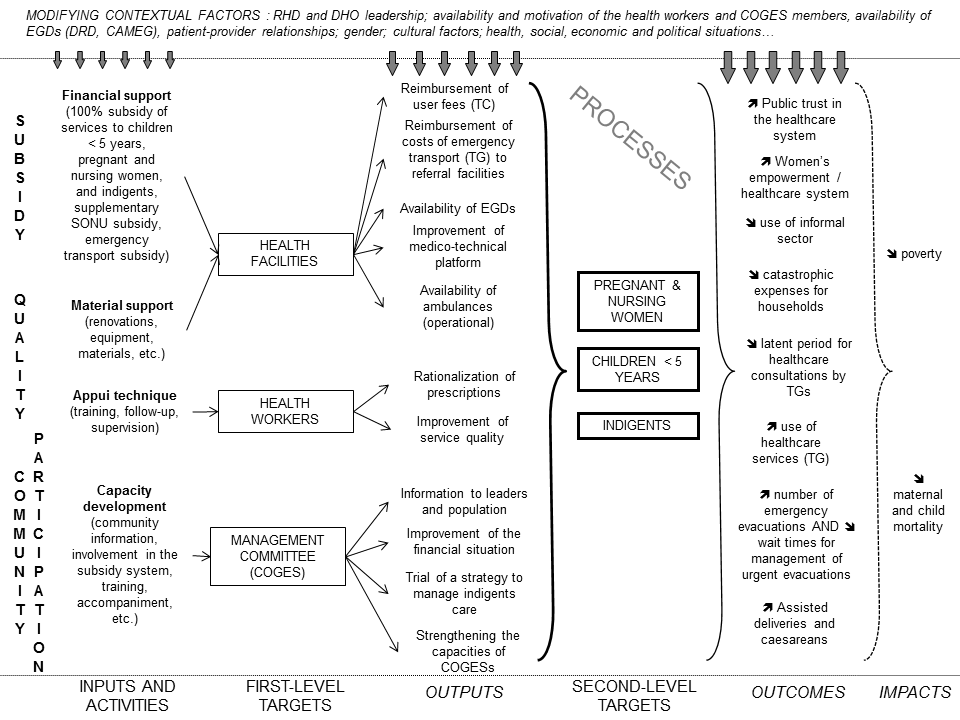
The key principle is to make healthcare services free at the point of service for vulnerable groups. In return, the COGESs are reimbursed for the costs of providing these services. The NGO acts as a third-party payer, a role that otherwise would fall to the State or a national health insurance.

Intervention model

Intervention model

The NGO has implemented a variety of activities to support this exemption measure, in collaboration with the health district teams and the COGESs:  information and public awareness campaigns, community mobilization, training for COGES members, training and medical supervision for health workers, reimbursement of medical acts, financial monitoring, etc. Over the short term, the aim of this experiment is to improve access to health and social promotion centers (CSPS) for the three target populations, as well as to strengthen the empowerment of COGESs and the target publics, to improve COGES’ financial positions, and to reduce healthcare expenditures. Over the long term, this intervention should help to improve people’s health and lower households’ risk of falling into poverty.

Access to healthcare for vulnerable groups in West Africa

Access to healthcare for vulnerable groups in West Africa

HELP Allemagne

Background

In West Africa, the health status of the population is precarious, particularly because of very poor access to healthcare services. In 2008, the European Community Humanitarian Office (ECHO), the German NGO Help, and the Direction régionale de la santé (DRS) du Sahel in Burkina Faso decided to experiment with user fee exemptions for children under five and pregnant or breastfeeding women. The project’s two objectives are to:

  • provide medical treatment for vulnerable populations;
  • improve the national health policy.

The project has four components:

  • the intervention itself (subsidy for care provided to these vulnerable populations and measures to support this subsidy);
  • evaluative research on the intervention;
  • transfer and dissemination of the knowledge produced by the intervention;
  • advocacy for policy change.

For the research and knowledge transfer activities, the project established a scientific partnership with the University of Montreal Hospital Research Centre (CRCHUM), and in particular, with Professor Valéry Ridde as scientific advisor. The CRCHUM’s research and knowledge transfer mandate, which it carries out in collaboration with the other partners, includes 1) identifying knowledge needs and setting priorities, 2) producing knowledge, 3) disseminating that knowledge, and 4) conducting activities to encourage its use.