Extension publications and misconceptions

Access to healthcare for vulnerable groups in West Africa

Knowledge transfer - Extension publications and misconceptions
Sans titre

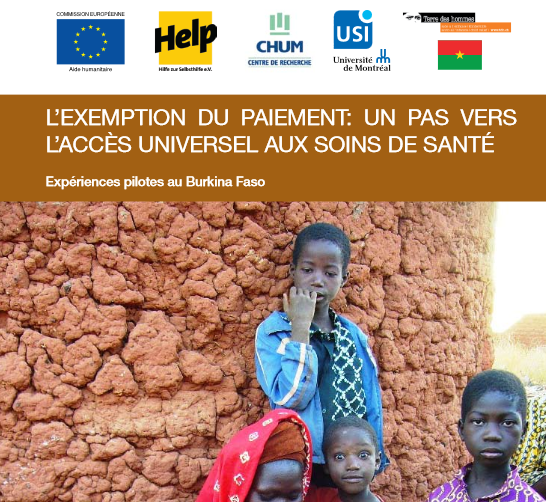
Ridde, V., & Queuille, L. (2010). L’exemption du paiement : un pas vers l’accès universel aux soins de santé - Expériences pilotes au Burkina Faso. Download
Multimedia

All sheets (french only) :


Ridde, V., & Queuille, L. (2013). Idée reçue 3 : les soins gratuits deresponsabilisent les populations et ne sont pas valorisés. Download
Ridde, V., & Queuille, L. (2013). Idée reçue 9 : “Les États africains n’ont pas les moyens de s’offrir la gratuité des soins !” (pp. 2012–2013). Download
Ridde, V., & Queuille, L. (2013). Idée reçue 7 : “Rendre les accouchements gratuits va provoquer une hausse des naissances !” Download
Ridde, V., & Queuille, L. (2013). Idée reçue 8 : “Les États africains ne sont pas capable de mettre en oeuvre la gratuité des soins !” Download
Ridde, V., & Queuille, L. (2013). Idée reçue 4 : “Quand les soins sont gratuits, la qualité est mauvaise !” Download
Ridde, V., & Queuille, L. (2013). Gratuité des soins en Afrique subsaharienne : en finir avec certaines idées reçues. OXFAM / CRCHUM / HELP. Download
Ridde, V., & Queuille, L. (2013). Idée reçue 2 : “La gratuité des soins ne profite pas a ceux qui en ont le plus besoin !” Download
Ridde, V., & Queuille, L. (2013). Idée reçue 6 : “La gratuité de soins entraîne la faillite des centres de santé !” Download
Ridde, V., & Queuille, L. (2013). Idée reçue 1 : “Il faut absolument une participation financière, aussi infime soit-elle !” Download
Ridde, V., & Queuille, L. (2013). Idée reçue 5 : “La gratuité des soins entraîne une surcharge de travail insurmontable pour le personnel de santé !” Download

Financing and access to health care in West Africa: empirical data, cartoons and received ideas.

Made by the designer Glez, this series of cartoon focuses on preconceived ideas that people can have about the implementation of free health care and health insurance coverage in Sub-Saharan Africa.

You will find under the flipbook a gallery of the caricatural pictures which the flipbook is made of and on the left of the page a complete brochure introducing a series of nine sheets aiming to show with evidences, how certain ideas about the principle of free care we regularly hear in the context of our knowledge transfer activities are lazy thoughts.


Flipbook: Healthcare financing and access in West Africa: Empirical and satirical!

Research fight against dengue

Recherches et interventions communautaires pour l'équité en santé au Burkina Faso

Axes de recherche et d'intervention

Partners
First Québec cross-disciplinary group devoted to studying knowledge transfer (KT) in the field of social interventions, specifically with regard to educational, health and community services.

First Québec cross-disciplinary group devoted to studying knowledge transfer (KT) in the field of social interventions, specifically with regard to educational, health and community services.


Logo IRSC

Canadian Institute of Health Research

The knoledge broker’s blog (french)

Lutte contre la Dengue

Dans un contexte où le paludisme impose un fardeau énorme à la population et au système de santé, la prise de conscience en 2013 des autorités envers la dengue et autres épisodes fébriles non paludiques, doit être prise au sérieux. La similitude des symptômes, l’absence de moyens de diagnostiques dans les centres de santé et le manque de connaissance à ce sujet est préoccupante. Cet axe a pour objectif d’accompagner les décideurs nationaux en leur fournissant des données probantes sur la présence de la Dengue et de son vecteur et en les accompagnants concernant des stratégie de formation des professionnels de santé et d’interventions de santé publique.

Ecouter l’émission de RFi du lundi 7 avril 2014 – Journée mondiale de la santé: les maladies vectorielles

Publications

V. Ridde, I. Agier, E. Bonnet, M. Carabali, R. Dabiré, T. Druetz, F. Fournet, A. Ly, C. Ocampo, B. Parra. (2014). La Dengue au Burkina Faso: pas de panique, mais soyons prudents. Download


Other research axis

Research and community-based interventions for health equity in Burkina Faso

Axes de recherche et d'intervention

Partners
First Québec cross-disciplinary group devoted to studying knowledge transfer (KT) in the field of social interventions, specifically with regard to educational, health and community services.

First Québec cross-disciplinary group devoted to studying knowledge transfer (KT) in the field of social interventions, specifically with regard to educational, health and community services.


Logo IRSC

Canadian Institute of Health Research

The knoledge broker’s blog (french)

Other research axis

Fight Against Malaria

This axis aims to assess the national policy in the fight against malaria and its interaction with interventions aiming to exempt payment of healthcare for children under the age of five (in some districts). A population survey in 2013 will assess the effects of these interventions on the health status of children less than five years of age.

 Publications to come

Insurance and Poverty

For many years, the government of Burkina Faso has shown interest in establishing universal health coverage including national health insurance. This research axis aims to support this change by namely evaluating public support concepts underlying the implementation of compulsory coverage and examining the policies that have been formulated and implemented specifically for those in need.

  Publications to come

Funding Based on the Results and Equity

The Ministry of Health has established an incentive system in early 2014 regarding the funding of health facilities based on their performance in 15 districts of the country. They added an equity section to this process to organize a community targeting system of the poor individuals in these districts to offer a free healthcare component. This research axis aims to participate in the evaluation of this intervention and more specifically in its emergence, establishment, implementation and its potential for improvement.

  Publications to come

Maternal Health

The national policy of price subsidy of birth deliveries has contributed to the increase in maternal health services. However, the removal of financial barriers can also cause an unnecessary recourse to caesarean sections. This axis aims to assess whether this has been the case and to assist health professionals in their training so as to better target the needs of pregnant women. The use of mobile phone technology will be considered in interventions that will be implemented.

 Publications to come


Trauma research axis

Research and community-based interventions for health equity in Burkina Faso

Axes de recherche et d'intervention

Partners
First Québec cross-disciplinary group devoted to studying knowledge transfer (KT) in the field of social interventions, specifically with regard to educational, health and community services.

First Québec cross-disciplinary group devoted to studying knowledge transfer (KT) in the field of social interventions, specifically with regard to educational, health and community services.


Logo IRSC

Canadian Institute of Health Research

The knoledge broker’s blog (french)

Developing a System to Monitor Road Accidents in Ouagadougou to Reduce Accident Burden

Traffic accidents have become a worldwide public health issue since the late 20th century. Today, they cause as many victims as major pandemics such as malaria and tuberculosis, and are the leading cause of death in the world in people between 10 and 45 years old. In Africa, death by road accident is the 5th leading cause of death, while it is in the 10th place worldwide (WHO, 2013). Burkina Faso and its capital Ouagadougou are experiencing this new public health burden. The number of accidents with injuries is increasing every year.

One of the research questions in the Trauma axis of the equity program is to know where the road accidents with injury are most frequent in Ouagadougou so as to identify and understand the spatial differentiation of this burden as well as to define the victims’ profile. How are they supported by first aid and hospital emergency services? How are victims being monitored by physicians? What are the economic consequences for these people?

The overall objective of this research’s axis is to understand the needs of vulnerable road users in order to fight against this burden. Several surveys will be undertaken to achieve this and will form the basis in the process of defining a community intervention that will aim to reduce the vulnerability of populations most at risk.


Publication (french)

Bonnet, E., Nikiema, A., & Lechat, L. (2014). Développer un système de surveillance des accidents de la route à Ouagadougou pour en diminuer le fardeau. Download

Policy briefs

Research and community-based interventions for health equity in Burkina Faso

Axis of research and intervention

Partners

First Québec cross-disciplinary group devoted to studying knowledge transfer (KT) in the field of social interventions, specifically with regard to educational, health and community services.

First Québec cross-disciplinary group devoted to studying knowledge transfer (KT) in the field of social interventions, specifically with regard to educational, health and community services.


Logo IRSC

Canadian Institute of Health Research

The knoledge broker’s blog (french)

Research and community-based interventions for health equity in Burkina Faso


Policy briefs (french)


Diabaté, S., Haddad, S., Druetz, T., Bonnet, E., Kuanda, S., & Ridde, V. (2013). Les besoins des ménages n’ont pas été comblés par la campagne de distribution des moustiquaires imprégnées de 2010. [pdf]

Druetz, T., Bonnet, E., Ridde, V., Kouanda, S., & Haddad, S. (2013). Les implications pratiques des variations micro-territoriales de la transmission du paludisme pour la planification des interventions. [pdf]

Druetz, T., Haddad, S., Kouanda, S., & Ridde, V. (2013). Les enfants de moins de 5 ans sont rarement conduits à un agent de santé communautaire lorsqu’ils présentent de la fièvre. [pdf]

Druetz, T., Kadidiatou, K., Haddad, S., Kouanda, S., & Ridde, V. (2013). Les perceptions qu’ont les agents de santé communautaires de leur implication dans la prise en charge du paludisme sont propices à leur bonne performance. [pdf]

Farquet, V., Haddad, S., & Ridde, V. (2013). La mise à disposition des tests de dépistage rapide du paludisme n’a pas conduit à une modification franche des pratiques de prescription. Les résultats sont hétérogènes. [pdf]

Fregonese, F., Haddad, S., Druetz, T., Kuanda, S., & Ridde, V. (2013). La concentration des enfants malades dans les familles et son implication pour le dépistage et le traitement des fratries. [pdf]

Haddad, S., Bonnet, E., Druetz, T., Kuanda, S., & Ridde, V. (2013). Des foyers de haute transmission persistants entretiennent et amplifient le risque paludique. [pdf]

Ridde, V., Druetz, T., Poppy, S., Kouanda, S., & Haddad, S. (2013). Le programme de lutte contre le paludisme au Burkina Faso a été bien implanté mais une couverture réduite et des retards importants peuvent avoir été préjudiciables à son efficacité. [pdf]

Zongo, S., Ridde, V., & Haddad, S. (2013). Les tests de diagnostic rapide du paludisme sont utiles, mais ils ne sont pas toujours disponibles ni pris en compte pour le diagnostic et les prescriptions. [pdf]

Some, D. T., & Dagenais, C. (2013). Que faire pour augmenter l’adhésion aux mutuelles de santé au Burkina Faso ? [pdf]

Boileau-Falardeau, M., Dagenais, C., & Ridde, V. (2013). Le courtage des connaissances : une solution pour favoriser l’utilisation de la recherche au Burkina Faso. [pdf]